

For the past decade, sports betting has been the fastest-growing gambling industry in the United States. Since legalization spread state-by-state after the 2018 Supreme Court ruling, sportsbooks like DraftKings and FanDuel have handled hundreds of billions in wagers.
But a new competitor is quietly emerging.
Prediction markets, platforms that allow users to trade probabilities on real-world events, are beginning to attract serious attention from traders, technologists, and regulators. Companies like Kalshi and Polymarket are building marketplaces where the future itself becomes a tradable asset.
Instead of betting on the Chiefs to cover the spread, users can trade contracts on questions like:
- Will the Federal Reserve cut interest rates this year?
- Will a presidential candidate win the election?
- Will inflation exceed a certain level?
- Will a geopolitical event occur?
In other words, the market isn’t a game; it’s the probability of reality itself.
How Sports Betting Works
Traditional sportsbooks operate as market makers. They set odds and take the other side of wagers while adjusting prices to manage risk.
Example:
| Bet Type | Example |
|---|---|
| Spread | Chiefs -3 |
| Total | Lakers/Warriors Over 229 |
| Player Prop | Jokic Over 9.5 assists |
The sportsbook controls pricing and collects a built-in margin (the vig).
That structure has powered the explosive growth of companies like DraftKings and FanDuel, turning sports betting into a multi-billion-dollar U.S. industry.
But the system still revolves around entertainment betting on games.
How Prediction Markets Work
Prediction markets operate more like financial exchanges.
Participants trade contracts representing the probability of an event occurring. Prices move based on supply and demand, very similar to trading on Robinhood.
Example market:
| Event | Price |
|---|---|
| Candidate wins election | 64¢ |
| Candidate loses election | 36¢ |
If the event happens, the contract settles at $1.
If it doesn’t happen, it settles at $0.
The market price, therefore, represents the collective probability of the event.
A 64¢ contract = 64% implied probability.
This makes prediction markets like Polymarket function like crowdsourced forecasting systems.
Key Differences Between the Two Industries
| Category | Sports Betting | Prediction Markets |
|---|---|---|
| Market maker | Sportsbook | Traders |
| Pricing | Odds set by bookmaker | Market-driven probabilities |
| Edge | Handicapping sports | Information advantage |
| Market scope | Games & players | Any real-world event |
| Settlement | Game outcome | Event outcome |
In sports betting, bettors try to beat the sportsbook.
In prediction markets, traders try to beat each other’s information.
Why Prediction Markets Are Growing
Several forces are pushing prediction markets into the spotlight:
Information Trading
Prediction markets convert news and information into tradable prices.
Political developments, economic data, and corporate announcements can move markets instantly.
Infinite Market Topics
Sports betting is limited by the number of games.
Prediction markets can cover virtually anything:
- elections
- macroeconomics
- geopolitics
- entertainment
- weather
- corporate outcomes
- even aliens
Financial Market Crossover
Some traders see prediction markets as a new class of derivatives tied to real-world events.
Instead of trading stock prices, participants trade probabilities about the future.
Top 2026 Prediction Market Apps Comparison
Below is a detailed comparison of the leading prediction market apps available in the U.S. (with availability and features):
| App | Event Types | Liquidity & Volume | Major Strengths | Regulation |
|---|---|---|---|---|
| Kalshi | Politics, Econ, Sports, Culture | High ($4.4B+ in trading) | Regulated, broad events, strong liquidity | CFTC regulated |
| Polymarket | Sports, Culture, Crypto | Very High (Global leader) | Tight spreads, decentralized roots | Partial U.S. availability |
| Robinhood Markets | Sports, Politics | Moderate | Integrated with trading app | Regulated |
| Crypto.com & Underdog | Sports futures | Moderate | Fast growing | CFTC-linked |
| PredictIt / ForecastEx | Politics | Variable | Deep political markets | Regulatory transition |
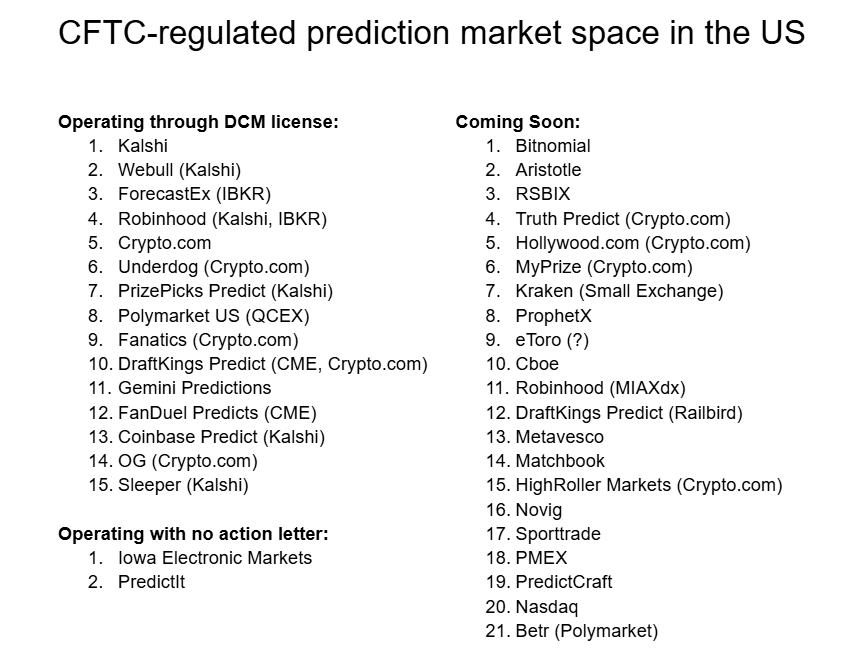
Can Prediction Markets Overtake Sports Betting?
Sports betting still dwarfs prediction markets in scale today, but the lines between the two industries are starting to blur. Major sportsbooks like DraftKings and FanDuel have both signaled growing interest in event-based and financial-style markets, while newer platforms like Underdog Predict are experimenting with products that look increasingly similar to prediction trading.
The shift isn’t accidental. Legal sportsbooks in the U.S. are facing rising state tax rates and regulatory costs that are squeezing margins, with several states now imposing tax structures that significantly cut into operator profitability. As a result, companies are exploring alternative market formats that behave more like exchanges than traditional sportsbooks.
Prediction markets also offer something sportsbooks fundamentally don’t: limitless subject matter. Sportsbooks are confined to games and player statistics, but prediction markets can cover virtually any real-world outcome — elections, economic policy, corporate decisions, geopolitical events, even weather. Every major global development can theoretically become a tradable contract.
That’s why some industry executives believe prediction markets could eventually evolve into a major information layer for financial markets, complementing traditional exchanges rather than replacing them.
In that vision:
- Prediction markets price the probability of events
- Sportsbooks handle entertainment betting
- Financial markets price assets
The Bigger Picture
Sports betting turned games into tradable outcomes. Prediction markets go one step further; they turn the future itself into a marketplace.
For traders, analysts, and bettors alike, the shift represents something new:
Not just betting on what already exists.
But trading what might happen next.

